Category:
Posted on November 12, 2024
Syphilis is a sensitive topic that requires both clinical accuracy and empathetic communication. In the PLAB 2 OSCE, handling a syphilis case involves taking a detailed history, performing an examination, and educating the patient on treatment and prevention, all while maintaining a non-judgmental and professional tone. This guide walks you through an effective approach to confidently manage the syphilis station in your exam.
Begin by introducing yourself and confirming the patient's identity:
“Hi, I’m one of the junior doctors in this GP surgery. Can I confirm your name and age, please?”
After confirming, address the patient by their preferred name to establish rapport. If they appear embarrassed, reassure them:
“There’s no need to feel embarrassed. We’re here to help.”
Ask open-ended questions to let the patient describe their symptoms in detail:
“Can you tell me more about what’s going on?”
For syphilis, focus on ODIPARA (Onset, Duration, Intensity, Progression, Associated symptoms, Relieving factors, Aggravating factors):
Onset: “How did it start?”
Duration: “How long has it been there?”
Size/Shape/Color: “What is the size and shape of the ulcer? What color is it?”
Associated Symptoms: “Any other symptoms, such as rashes, lumps, or discharge?”
Continue with a thorough evaluation of symptoms related to syphilis and other potential infections (FLAWS):
“Any recent fever, lumps, flu-like illness, tiredness, weight loss, or headaches?”
In sexually transmitted infection cases, social and sexual history is crucial:
Contact History: “Have you been exposed to someone with similar skin lesions?”
Sexual Activity: “Are you currently sexually active?” “Do you have multiple partners?” “Do you use condoms?”
Sexual Orientation and Practices: “May I ask about your sexual orientation?” “What routes of sex do you prefer?”
This part of the history should be approached professionally, ensuring the patient feels comfortable and respected.
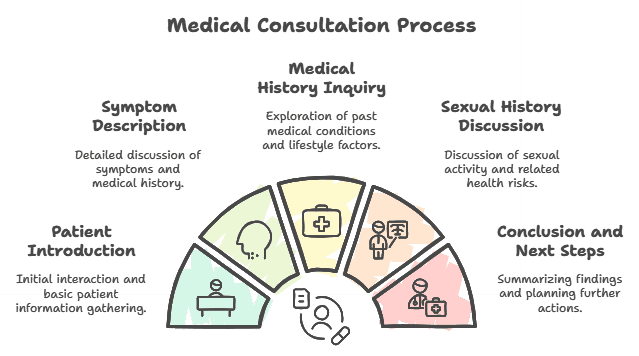
Below is a diagram summarizing what we've covered above.

Politely request to perform a general physical examination (GPE) and examine the ulcer:
“If you don’t mind, I’d like to check your vital signs and examine the ulcer to understand better.”
Look for other syphilis-related signs, such as rashes on the palms and soles or white patches in the mouth.
Based on the history and examination, provide a likely diagnosis:
“From what you’ve told me and my examination, it seems like you may have syphilis. Do you have any idea what syphilis is?”
Explain syphilis in simple terms:
“Syphilis is a bacterial infection usually transmitted through sexual contact. It’s treatable with antibiotics.”
Outline the management plan in a clear and organized manner:
Investigations:
“We’ll run some tests, including routine bloods and specific antibody tests, to confirm the diagnosis.”
Refer to a
GUM Clinic
(Genitourinary Medicine) for specialized care.
Treatment:
Penicillin injections (or antibiotic tablets if allergic).
“Usually, a single dose is effective, but if the infection is long-standing, we may need multiple doses.”
Lifestyle Advice:
“Avoid sexual activity for at least 2 weeks after treatment finishes.”
Partner Notification: “It’s important to inform your partners so they can get tested and treated if necessary.”
HIV Testing: “We usually offer HIV tests for anyone with an STI. Would you like to have one?”
Prevention Tips:
Safe sex practices (condoms, dental dams).
Avoid sharing needles if injecting drugs.
Throughout the consultation, address the patient’s Ideas, Concerns, and Expectations:
Concerns: “Do you have any concerns about the condition or treatment?”
If the patient asks about treatment, explain the antibiotic regimen.
If they ask about recurrence, reassure that reinfection can happen but preventive measures reduce the risk.
Expectations: “Is there anything you were hoping to discuss today?”
Provide clear safety-netting advice to help the patient recognize complications or recurrences:
“If you notice symptoms like sore throat, white patches in your mouth, tingling, or vision problems, please return to the GP.”
Arrange follow-up appointments to ensure treatment effectiveness and monitor for any further issues.
End the consultation with reassurance:
“We’ll follow up to make sure everything is progressing well. Remember, this condition is treatable, and we’re here to support you every step of the way.”

The syphilis station in PLAB 2 OSCE tests your ability to handle sensitive information while maintaining clinical thoroughness. By following this structured approach—covering history, examination, management, and empathetic communication—you can effectively manage syphilis cases with confidence. This guide provides a clear framework to ensure you address all necessary points, making you well-prepared for the exam.
Become part of a platform crafted by doctors who've been in your shoes and know what it takes to pass PLAB 2. Don't miss your chance to practice smarter and get ahead.
✓ No credit card required • ✓ Instant access • ✓ Made by doctors